by Andy Huffman | May 21, 2026 | Roofing Tips
Attic Ventilation and Your Roof — Why It Matters More Than Most Homeowners Realize
If there’s one roofing-related topic most homeowners know almost nothing about, it’s attic ventilation. Yet inadequate attic ventilation is one of the top three causes of premature roof failure — and it voids your GAF warranty if not corrected.
Why Attic Ventilation Matters
Your attic is not supposed to be the same temperature as your house. It’s supposed to be close to outdoor ambient temperature — both summer and winter.
In summer: An improperly ventilated attic can reach 150-160°F on a hot day. This superheated air bakes your shingles from below, dramatically accelerating aging. Manufacturers’ rated lifespans assume adequate ventilation — without it, you may get 12-15 years from shingles rated for 25-30 years.
In winter: Heat rising from your living space accumulates in an under-ventilated attic, warming the roof deck and causing the snow-melt/refreeze cycle that creates ice dams. (See our ice dam prevention guide for details.)
Year-round: Moisture from cooking, bathing, and breathing rises into the attic. Without adequate air movement, this moisture condenses on the underside of the roof deck — causing mold, rot, and structural damage invisible from the outside.
How Ventilation Is Supposed to Work
Proper attic ventilation is a balanced system with two components that must both be present:
Intake ventilation (low): Cool outside air enters your attic at the low point — typically through vented soffit panels along the eaves. This is the inlet.
Exhaust ventilation (high): Warm, moist air exits at the high point — typically through a ridge vent running the length of your roof peak, or through individual static vents. This is the outlet.
The physics of the system: cool dense air enters at the bottom, pushes warm air up and out at the top — passively, without any power. A properly balanced system moves air continuously even on calm days.
The Most Common Ventilation Problems
Only exhaust, no intake (most common issue):
Ridge vents installed without corresponding soffit intake. Air can’t circulate properly without both inlet and outlet.
Soffit vents blocked by insulation:
During attic insulation upgrades, insulation is frequently pushed too far toward the eave, blocking soffit vents completely. Ventilation baffles (channels that hold insulation back from the soffit) prevent this — they’re required but often skipped.
Too few vents:
Building code requires a minimum net free area of ventilation. Many older homes, and some newer ones, simply don’t have enough vent area for the attic square footage.
Powered vents without adequate intake:
Powered attic ventilators create negative pressure that can pull conditioned air from your living space if intake is inadequate — actually increasing energy costs while providing minimal ventilation benefit.
The Minimum Standard for Northwest Indiana and Illinois Homes
Current building code requires 1 square foot of net free ventilation area per 150 square feet of attic floor space (with balanced intake and exhaust), or 1:300 with balanced intake and exhaust.
The Department of Energy recommends R-49 to R-60 insulation in our climate zone, installed correctly with baffles that maintain soffit vent airflow.
What Alamo Does on Every Project
On every roofing project, we assess your attic ventilation before installation begins. If we find:
– Blocked soffit vents: we install or re-install ventilation baffles
– Insufficient ridge vent: we recommend and install proper continuous ridge vent
– Missing or inadequate intake: we add soffit venting as needed
We don’t skip this. GAF requires adequate ventilation as a condition of their enhanced warranties — and more importantly, inadequate ventilation will shorten the life of the roof we install. We’re not willing to install a roof that will fail prematurely because of ventilation issues we didn’t correct.
Call (219) 224-2636 if you have questions about your attic ventilation.
About Alamo Roofing Contractors
Alamo Roofing Contractors is a GAF Master Elite certified roofing contractor serving Northwest Indiana and northern Illinois since 2017. Based in Portage, Indiana, we serve Lake County, Porter County, LaPorte County, Cook County, Will County, and DuPage County.
[Schedule Your Free Estimate] → https://api.leadconnectorhq.com/widget/booking/DKc0HhICa64zXLn8XJtX
[Call (219) 224-2636] → tel:+12192242636
Mon–Fri 9AM–5PM | Sat 9AM–3PM | 24/7 Emergency Storm Response
by Andy Huffman | May 21, 2026 | Roofing Tips
If there’s one roofing-related topic most homeowners know almost nothing about, it’s attic ventilation. Yet inadequate attic ventilation is one of the top three causes of premature roof failure — and it voids your GAF warranty if not corrected.
Why Attic Ventilation Matters
Your attic is not supposed to be the same temperature as your house. It’s supposed to be close to outdoor ambient temperature — both summer and winter.
In summer: An improperly ventilated attic can reach 150-160°F on a hot day. This superheated air bakes your shingles from below, dramatically accelerating aging. Manufacturers’ rated lifespans assume adequate ventilation — without it, you may get 12-15 years from shingles rated for 25-30 years.
In winter: Heat rising from your living space accumulates in an under-ventilated attic, warming the roof deck and causing the snow-melt/refreeze cycle that creates ice dams. (See our ice dam prevention guide for details.)
Year-round: Moisture from cooking, bathing, and breathing rises into the attic. Without adequate air movement, this moisture condenses on the underside of the roof deck — causing mold, rot, and structural damage invisible from the outside.
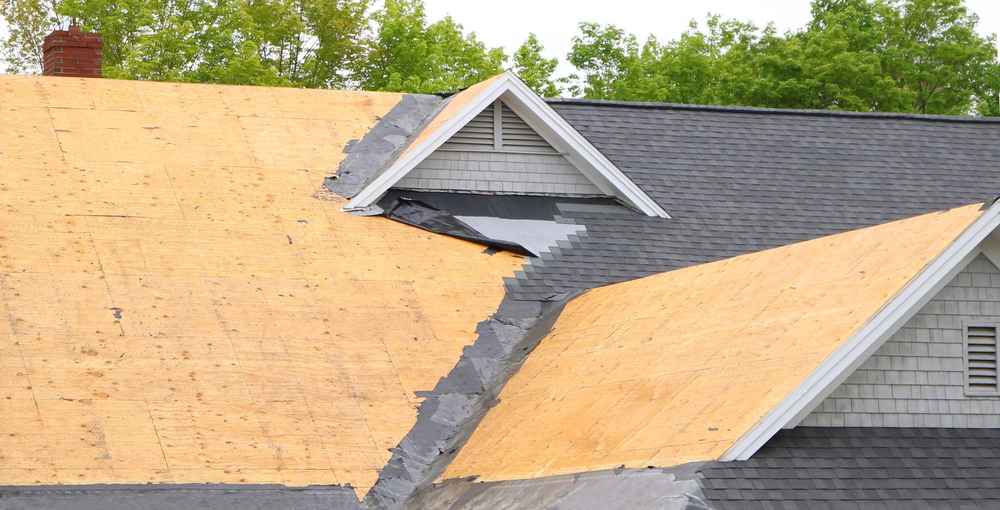
Professional inspection ensures no damage goes undetected
How Ventilation Is Supposed to Work
Proper attic ventilation is a balanced system with two components that must both be present:
Intake ventilation (low): Cool outside air enters your attic at the low point — typically through vented soffit panels along the eaves. This is the inlet.
Exhaust ventilation (high): Warm, moist air exits at the high point — typically through a ridge vent running the length of your roof peak, or through individual static vents. This is the outlet.
The physics of the system: cool dense air enters at the bottom, pushes warm air up and out at the top — passively, without any power. A properly balanced system moves air continuously even on calm days.
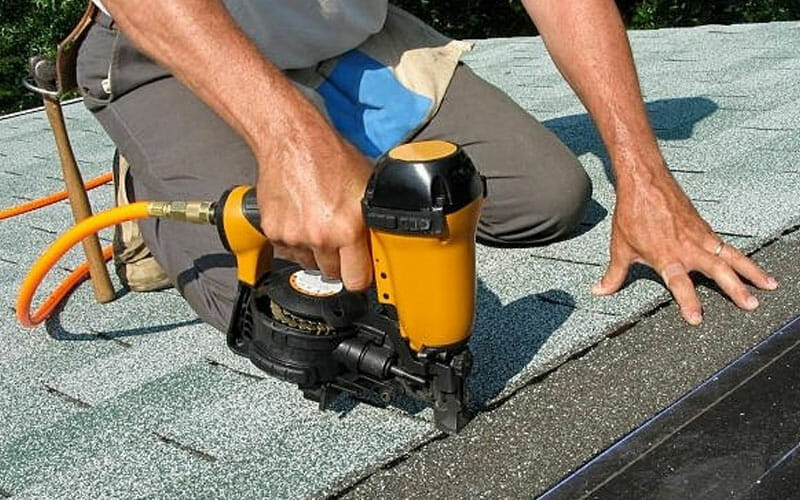
Quality materials and expert installation make the difference
The Most Common Ventilation Problems
Only exhaust, no intake (most common issue):
Ridge vents installed without corresponding soffit intake. Air can’t circulate properly without both inlet and outlet.
Soffit vents blocked by insulation:
During attic insulation upgrades, insulation is frequently pushed too far toward the eave, blocking soffit vents completely. Ventilation baffles (channels that hold insulation back from the soffit) prevent this — they’re required but often skipped.
💡 Pro Tip
Schedule a professional inspection within 30 days of any major storm. Early detection prevents costly repairs down the road.
Too few vents:
Building code requires a minimum net free area of ventilation. Many older homes, and some newer ones, simply don’t have enough vent area for the attic square footage.
Powered vents without adequate intake:
Powered attic ventilators create negative pressure that can pull conditioned air from your living space if intake is inadequate — actually increasing energy costs while providing minimal ventilation benefit.
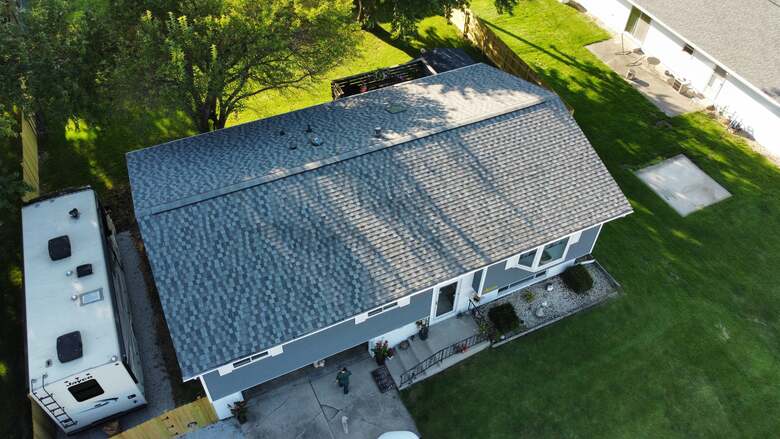
Alamo Roofing serves Lake County, Porter County & northern Illinois
The Minimum Standard for Northwest Indiana and Illinois Homes
Current building code requires 1 square foot of net free ventilation area per 150 square feet of attic floor space (with balanced intake and exhaust), or 1:300 with balanced intake and exhaust.
The Department of Energy recommends R-49 to R-60 insulation in our climate zone, installed correctly with baffles that maintain soffit vent airflow.
What Alamo Does on Every Project
On every roofing project, we assess your attic ventilation before installation begins. If we find:
- Blocked soffit vents: we install or re-install ventilation baffles
- Insufficient ridge vent: we recommend and install proper continuous ridge vent
- Missing or inadequate intake: we add soffit venting as needed
We don’t skip this. GAF requires adequate ventilation as a condition of their enhanced warranties — and more importantly, inadequate ventilation will shorten the life of the roof we install. We’re not willing to install a roof that will fail prematurely because of ventilation issues we didn’t correct.
Ready for Your Free Roof Inspection?
Call us at (219) 248-2194 or book online below.
Mon–Fri 9AM–5PM | Sat 9AM–3PM | 24/7 Emergency Storm Response
Schedule Your Free Roof Inspection
Get Your Free Roof Inspection
Free drone inspections across Lake County, Porter County & northern Illinois. Honest assessments — repair, replace, or no action needed.
(219) 248-2194
Book Online
Mon–Fri 9AM–5PM · Sat 9AM–3PM · 24/7 Emergency Storm Response
Schedule Your Free Roof Inspection
by Andy Huffman | May 18, 2026 | Roofing Tips
Architectural vs. 3-Tab Shingles — Why the Choice Matters for Midwest Homes
If you’re getting roofing estimates and don’t know the difference between architectural and 3-tab shingles, you may not realize what you’re agreeing to. This is a decision that affects your roof’s performance, appearance, and lifespan for the next 20-30 years.
What 3-Tab Shingles Are
3-tab shingles are the traditional flat shingle design that dominated residential roofing for decades. They’re called “3-tab” because each shingle strip has two cutouts that create the appearance of three separate tabs.
3-tab shingles are:
– Thinner (single layer of asphalt)
– Flat appearance with uniform shadow lines
– Lighter weight
– Lower cost ($75-$100 per square for materials)
– Typically rated for winds up to 60 mph
– 20-25 year manufacturer warranty (though rarely lasting that long in our climate)
What Architectural Shingles Are
Architectural shingles (also called laminate or dimensional shingles) have a second layer of asphalt bonded to the base — creating a thicker, textured product with a more three-dimensional appearance.
Architectural shingles are:
– Thicker (two layers of asphalt)
– Textured appearance with varied shadow patterns
– Heavier
– Higher cost ($90-$130 per square for materials)
– Typically rated for winds up to 110-130 mph (with qualifying installation)
– Lifetime manufacturer warranty with 50-year non-prorated coverage (with qualifying certification)
Why 3-Tab Shingles Underperform in Our Climate
Northwest Indiana and northern Illinois represent some of the most challenging conditions for 3-tab shingles:
Wind performance: Lake County and Porter County regularly see straight-line winds of 60-80 mph in severe storms. 3-tab shingles rated for 60 mph begin to fail exactly at the wind speeds our storms produce. Architectural shingles rated for 110-130 mph with LayerLock technology have a genuine performance advantage here.
Freeze-thaw cycling: 3-tab shingles’ thinner construction is more susceptible to cracking and seal failure through repeated freeze-thaw cycles. Architectural shingles’ greater mass and double-layer construction handle these cycles better.
Hail: Architectural shingles’ thicker profile provides better resistance to hail impact than 3-tab shingles. The Class 4 impact-resistant versions take this further.
The Cost Difference Is Smaller Than You Think
The premium for architectural over 3-tab shingles is typically $15-$30 per square in materials — on a 20-square roof, that’s $300-$600 in additional material cost.
On a $12,000-$15,000 roofing project, the upgrade from 3-tab to architectural shingles typically costs $400-$800 more — less than 5% of total project cost.
For that small premium, you get meaningfully better wind resistance, better hail performance, better freeze-thaw durability, better appearance, and a longer warranty — backed by the manufacturer for 50 years non-prorated (with GAF Master Elite installation).
Our Honest Recommendation
We don’t install 3-tab shingles on residential re-roofing projects in Northwest Indiana or northern Illinois for new customers unless there’s a specific reason — HOA requirement, budget constraint, or matching an existing section.
The performance difference in our climate is real, the cost difference is small, and the longer warranty coverage is more meaningful protection for homeowners.
Our standard recommendation: GAF Timberline HDZ architectural shingles with LayerLock technology — rated for 130 mph winds, Class 3 impact resistance, 50-year non-prorated material warranty with Golden Pledge workmanship coverage.
Call (219) 224-2636 to discuss the right shingle for your home.
About Alamo Roofing Contractors
Alamo Roofing Contractors is a GAF Master Elite certified roofing contractor serving Northwest Indiana and northern Illinois since 2017. Based in Portage, Indiana, we serve Lake County, Porter County, LaPorte County, Cook County, Will County, and DuPage County.
[Schedule Your Free Estimate] → https://api.leadconnectorhq.com/widget/booking/DKc0HhICa64zXLn8XJtX
[Call (219) 224-2636] → tel:+12192242636
Mon–Fri 9AM–5PM | Sat 9AM–3PM | 24/7 Emergency Storm Response
by Andy Huffman | May 18, 2026 | Roofing Tips
If you’re getting roofing estimates and don’t know the difference between architectural and 3-tab shingles, you may not realize what you’re agreeing to. This is a decision that affects your roof’s performance, appearance, and lifespan for the next 20-30 years.
What 3-Tab Shingles Are
3-tab shingles are the traditional flat shingle design that dominated residential roofing for decades. They’re called “3-tab” because each shingle strip has two cutouts that create the appearance of three separate tabs.
3-tab shingles are:
- tab shingles are:
- Thinner (single layer of asphalt)
- Flat appearance with uniform shadow lines
- Lighter weight
- Lower cost ($75-$100 per square for materials)
- Typically rated for winds up to 60 mph
- 20-25 year manufacturer warranty (though rarely lasting that long in our climate)
Professional inspection ensures no damage goes undetected
What Architectural Shingles Are
Architectural shingles (also called laminate or dimensional shingles) have a second layer of asphalt bonded to the base — creating a thicker, textured product with a more three-dimensional appearance.
Architectural shingles are:
- Thicker (two layers of asphalt)
- Textured appearance with varied shadow patterns
- Heavie
- Higher cost ($90-$130 per square for materials)
- Typically rated for winds up to 110-130 mph (with qualifying installation)
- Lifetime manufacturer warranty with 50-year non-prorated coverage (with qualifying certification)
Quality materials and expert installation make the difference
Why 3-Tab Shingles Underperform in Our Climate
Northwest Indiana and northern Illinois represent some of the most challenging conditions for 3-tab shingles:
Wind performance: Lake County and Porter County regularly see straight-line winds of 60-80 mph in severe storms. 3-tab shingles rated for 60 mph begin to fail exactly at the wind speeds our storms produce. Architectural shingles rated for 110-130 mph with LayerLock technology have a genuine performance advantage here.
💡 Pro Tip
Schedule a professional inspection within 30 days of any major storm. Early detection prevents costly repairs down the road.
Freeze-thaw cycling: 3-tab shingles’ thinner construction is more susceptible to cracking and seal failure through repeated freeze-thaw cycles. Architectural shingles’ greater mass and double-layer construction handle these cycles better.
Hail: Architectural shingles’ thicker profile provides better resistance to hail impact than 3-tab shingles. The Class 4 impact-resistant versions take this further.
Alamo Roofing serves Lake County, Porter County & northern Illinois
The Cost Difference Is Smaller Than You Think
The premium for architectural over 3-tab shingles is typically $15-$30 per square in materials — on a 20-square roof, that’s $300-$600 in additional material cost.
On a $12,000-$15,000 roofing project, the upgrade from 3-tab to architectural shingles typically costs $400-$800 more — less than 5% of total project cost.
For that small premium, you get meaningfully better wind resistance, better hail performance, better freeze-thaw durability, better appearance, and a longer warranty — backed by the manufacturer for 50 years non-prorated (with GAF Master Elite installation).
Our Honest Recommendation
We don’t install 3-tab shingles on residential re-roofing projects in Northwest Indiana or northern Illinois for new customers unless there’s a specific reason — HOA requirement, budget constraint, or matching an existing section.
The performance difference in our climate is real, the cost difference is small, and the longer warranty coverage is more meaningful protection for homeowners.
Our standard recommendation: GAF Timberline HDZ architectural shingles with LayerLock technology — rated for 130 mph winds, Class 3 impact resistance, 50-year non-prorated material warranty with Golden Pledge workmanship coverage.
Ready for Your Free Roof Inspection?
Call us at (219) 248-2194 or book online below.
Mon–Fri 9AM–5PM | Sat 9AM–3PM | 24/7 Emergency Storm Response
Schedule Your Free Roof Inspection
Get Your Free Roof Inspection
Free drone inspections across Lake County, Porter County & northern Illinois. Honest assessments — repair, replace, or no action needed.
(219) 248-2194
Book Online
Mon–Fri 9AM–5PM · Sat 9AM–3PM · 24/7 Emergency Storm Response
Schedule Your Free Roof Inspection
by Andy Huffman | May 14, 2026 | Roofing Tips
How to Choose a Roofing Contractor in Northwest Indiana — 10 Questions to Ask
Choosing the wrong roofing contractor is one of the most expensive home improvement mistakes you can make. A bad installation can cost you $5,000-$15,000 in premature repairs, voided warranties, and water damage.
Here are the 10 questions every Northwest Indiana and northern Illinois homeowner should ask before signing any roofing contract.
1. Are you GAF Master Elite certified?
This is the single most important question. GAF Master Elite contractors (fewer than 3% of all U.S. roofers) can offer the Golden Pledge warranty — 25-30 years of workmanship coverage backed by GAF directly. Contractors who are not Master Elite cannot offer this.
Ask them to confirm their exact certification level and verify it at gaf.com/en-us/roofing-contractors/verify.
2. Are you licensed in Indiana AND Illinois?
If you’re in Illinois, verify the contractor holds an Illinois roofing license through the IDFPR (idfpr.illinois.gov). Indiana and Illinois do not have reciprocal licensing — an Indiana license does not authorize work in Illinois. An unlicensed contractor in Illinois cannot legally pull permits.
3. Can I see your certificate of insurance?
Ask for a certificate of insurance showing both general liability AND workers’ compensation with current dates. General liability protects your property. Workers’ comp protects you if a worker is injured on your property. Don’t accept verbal assurances — ask for the actual certificate.
4. How long have you operated in this specific area?
A contractor with 5+ years of Google reviews spanning multiple years in your market has a track record you can verify. Contractors with clusters of reviews only around storm events are a different story.
5. Do you handle insurance claims directly?
Ask: “Will you be present during the adjuster’s inspection? Will you prepare a supplemental claim if the adjuster’s estimate is lower than yours?” A contractor who says no to both is leaving money on the table for you.
6. What specific warranty can you offer on this project?
Get the exact warranty level in writing. “Lifetime warranty” means different things from different manufacturers. Ask specifically: Is this a material warranty only, or does it include workmanship? Who backs the workmanship warranty — you or the manufacturer? How long does workmanship coverage last?
7. Will you pull all required permits?
Every roofing project in Lake County and Porter County requires permits. The same is true for incorporated Illinois municipalities. Any contractor who suggests skipping permits is creating liability for you.
8. Who supervises the installation on my specific project?
Ask who will be physically on your roof supervising the work. Get a name. Ask how many years they’ve been installing roofs. Quality control varies enormously between contractors.
9. Can I see references from projects completed in the last 12 months?
Ask for 3 recent references in your area. Call them. Ask specifically about communication, cleanup, and whether there were any post-installation issues.
10. What is your process if I have a problem after installation?
Find out exactly who to call, what the response time commitment is, and what the process is for warranty claims. A contractor who’s vague about this is a red flag.
Red Flags to Watch For
- Door-to-door solicitation right after a storm — legitimate local contractors don’t do this
- Unusually low bid — often reflects lower-quality materials, skipped steps, or no permit
- Pressure to sign immediately — quality contractors don’t create artificial urgency
- No physical local address — out-of-state storm chasers operate this way
- Payment demanded upfront — standard practice is a deposit at signing, balance at completion
Why Alamo Roofing Answers All 10
- GAF Master Elite since 2021 — verifiable at gaf.com
- Licensed in Indiana and Illinois (unlimited IL license)
- Certificate of insurance available on request
- Based in Portage, Indiana since 2017 — 8 years of verifiable local history
- Full insurance claim assistance at no charge
- GAF Golden Pledge warranty on qualifying projects
- All permits pulled — we handle everything
- Free estimates and drone inspections
Call (219) 224-2636 — we welcome every one of these questions.
About Alamo Roofing Contractors
Alamo Roofing Contractors is a GAF Master Elite certified roofing contractor serving Northwest Indiana and northern Illinois since 2017. Based in Portage, Indiana, we serve Lake County, Porter County, LaPorte County, Cook County, Will County, and DuPage County with residential and commercial roofing, siding, gutters, and exterior services.
[Schedule Your Free Estimate] → [https://api.leadconnectorhq.com/widget/booking/DKc0HhICa64zXLn8XJtX]
[Call (219) 224-2636] → tel:+12192242636
Mon–Fri 9AM–5PM | Sat 9AM–3PM | 24/7 Emergency Storm Response