by Andy Huffman | Aug 20, 2026 | Commercial Roofing
If you manage commercial properties in Lake County, Cook County, or Will County, your roofing decisions affect tenant satisfaction, property values, and your own liability exposure. This guide is written specifically for property managers — not building owners making a one-time decision, but professionals managing multiple properties across an ongoing portfolio.
Building a Roofing Budget That Doesn’t Surprise You
The most common roofing mistake property managers make is reactive budgeting — allocating for repairs as they come up rather than planning for replacement on a schedule.
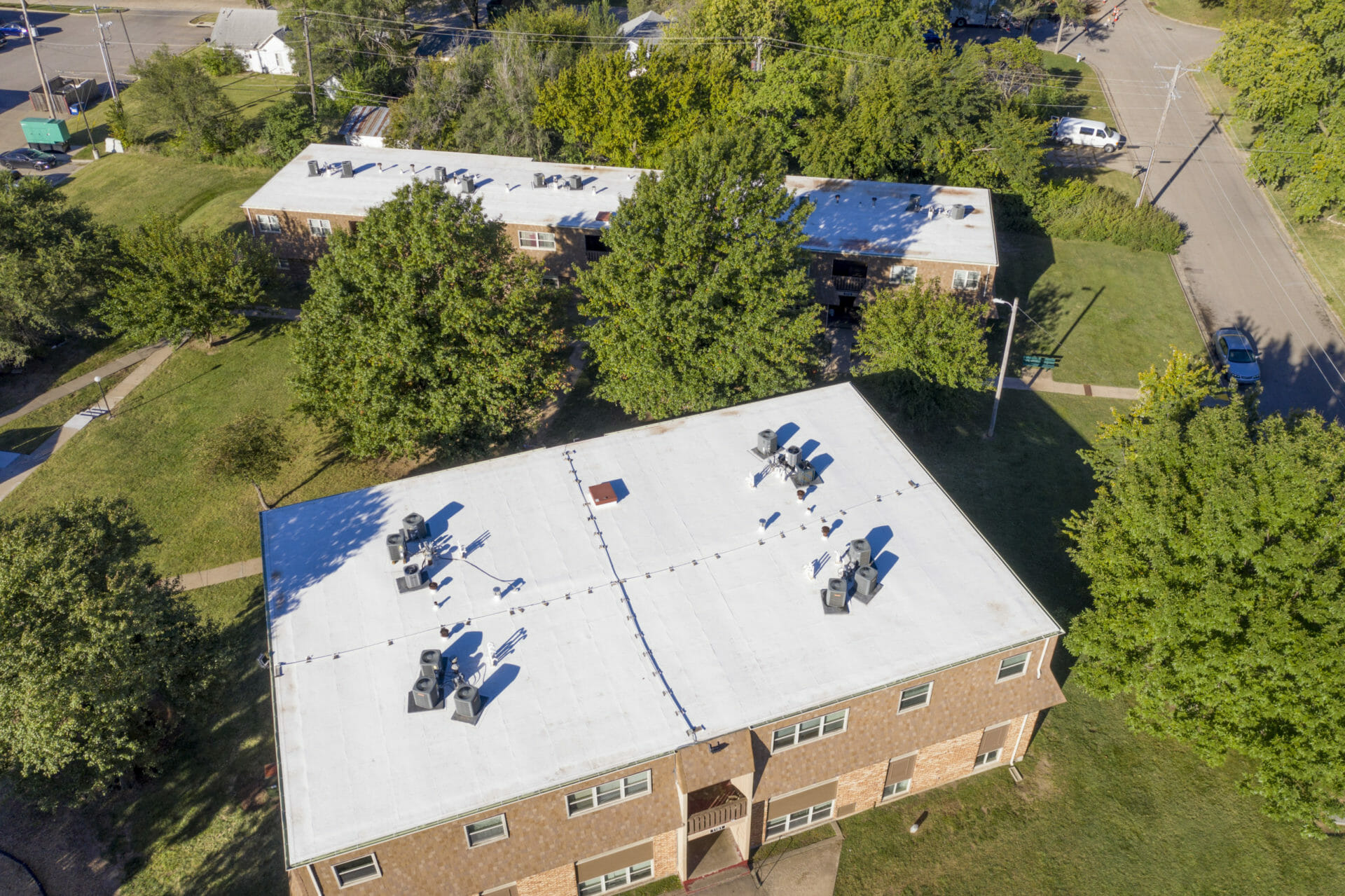
The replacement cycle: Commercial flat roofs in our climate have realistic lifespans of:
– TPO: 20-30 years
– EPDM: 25-35 years
– Modified Bitumen: 20-30 years
– Coated systems: Varies by coating type and substrate condition
Build a property-by-property replacement schedule based on installation date and system type. Budget replacement costs 3-5 years before you expect to need them — commercial roofing projects require planning, permitting, and contractor lead time.
Reserve fund recommendation: For a 10,000 square foot commercial building with a $100,000 replacement cost and 25-year lifespan, budget $4,000 per year in reserve to fund eventual replacement without a cash crisis.
Professional inspection ensures no damage goes undetected
Maintenance Programs — The Best Investment You Can Make
A bi-annual maintenance program (spring and fall inspection plus preventive repairs) consistently extends commercial roof lifespans by 5-10 years compared to reactive maintenance.
What a professional maintenance program includes:
- Full membrane inspection
- Drain clearing and assessment
- Seam probing and resealing as needed
- Penetration flashing resealing
- Written condition report with photos
- Priority emergency response
Annual program cost for a typical commercial building in our area: $500-$1,500 — a fraction of the cost of a single emergency repair.
Quality materials and expert installation make the difference
Vendor Selection for Your Portfolio
Managing multiple commercial properties means you need consistent, reliable roofing vendors who understand commercial work and respond predictably.
What to look for in a commercial roofing partner:
💡 Pro Tip
Schedule a professional inspection within 30 days of any major storm. Early detection prevents costly repairs down the road.
- Dedicated commercial team (not just a residential contractor who does occasional commercial work)
- Manufacturer certification for the systems they install
- 24/7 emergency response capability
- Consistent documentation (condition reports, photos, repair records)
- References from property management companies
Alamo Roofing serves commercial property managers across Lake County Indiana and Cook/Will County Illinois with dedicated commercial roofing services including maintenance programs.
Alamo Roofing serves Lake County, Porter County & northern Illinois
Emergency Protocol — Before a Leak Happens
Every property should have a documented emergency roofing protocol before a leak occurs:
- Immediate interior protection: Document which staff member is responsible for deploying buckets, moving equipment, and protecting tenants
- Emergency contact: Have Alamo’s 24/7 number in your property management system: (219) 248-2194
- Insurance contact: Know your commercial property policy’s claims process
- Documentation responsibility: Designate who takes photos and documents damage for the insurance claim
- Tenant communication: Know your lease obligations regarding response time and tenant notification
Insurance Claims for Commercial Properties
Commercial property insurance claims for roofing damage follow a similar process to residential but with larger stakes and more documentation requirements.
Key differences:
- Business interruption coverage may be relevant if tenants are displaced
- Contents damage claims for tenant property damage can be complex
- Code compliance upgrades may be required and should be included in the claim
- Commercial claims often take longer to resolve — document everything
Alamo assists commercial property managers with damage documentation and adjuster coordination for Lake County and northern Illinois commercial properties.
Ready for Your Free Roof Inspection?
Call us at (219) 248-2194 or book online below.
Mon–Fri 9AM–5PM | Sat 9AM–3PM | 24/7 Emergency Storm Response
Schedule Your Free Roof Inspection
Get Your Free Roof Inspection
Free drone inspections across Lake County, Porter County & northern Illinois. Honest assessments — repair, replace, or no action needed.
(219) 248-2194
Book Online
Mon–Fri 9AM–5PM · Sat 9AM–3PM · 24/7 Emergency Storm Response
Schedule Your Free Roof Inspection
by Andy Huffman | Aug 20, 2026 | Commercial Roofing
The Property Manager’s Guide to Commercial Roofing in Northwest Indiana and Illinois
If you manage commercial properties in Lake County, Cook County, or Will County, your roofing decisions affect tenant satisfaction, property values, and your own liability exposure. This guide is written specifically for property managers — not building owners making a one-time decision, but professionals managing multiple properties across an ongoing portfolio.
Building a Roofing Budget That Doesn’t Surprise You
The most common roofing mistake property managers make is reactive budgeting — allocating for repairs as they come up rather than planning for replacement on a schedule.
The replacement cycle: Commercial flat roofs in our climate have realistic lifespans of:
– TPO: 20-30 years
– EPDM: 25-35 years
– Modified Bitumen: 20-30 years
– Coated systems: Varies by coating type and substrate condition
Build a property-by-property replacement schedule based on installation date and system type. Budget replacement costs 3-5 years before you expect to need them — commercial roofing projects require planning, permitting, and contractor lead time.
Reserve fund recommendation: For a 10,000 square foot commercial building with a $100,000 replacement cost and 25-year lifespan, budget $4,000 per year in reserve to fund eventual replacement without a cash crisis.
Maintenance Programs — The Best Investment You Can Make
A bi-annual maintenance program (spring and fall inspection plus preventive repairs) consistently extends commercial roof lifespans by 5-10 years compared to reactive maintenance.
What a professional maintenance program includes:
– Full membrane inspection
– Drain clearing and assessment
– Seam probing and resealing as needed
– Penetration flashing resealing
– Written condition report with photos
– Priority emergency response
Annual program cost for a typical commercial building in our area: $500-$1,500 — a fraction of the cost of a single emergency repair.
Vendor Selection for Your Portfolio
Managing multiple commercial properties means you need consistent, reliable roofing vendors who understand commercial work and respond predictably.
What to look for in a commercial roofing partner:
– Dedicated commercial team (not just a residential contractor who does occasional commercial work)
– Manufacturer certification for the systems they install
– 24/7 emergency response capability
– Consistent documentation (condition reports, photos, repair records)
– References from property management companies
Alamo Roofing serves commercial property managers across Lake County Indiana and Cook/Will County Illinois with dedicated commercial roofing services including maintenance programs.
Emergency Protocol — Before a Leak Happens
Every property should have a documented emergency roofing protocol before a leak occurs:
- Immediate interior protection: Document which staff member is responsible for deploying buckets, moving equipment, and protecting tenants
- Emergency contact: Have Alamo’s 24/7 number in your property management system: (219) 224-2636
- Insurance contact: Know your commercial property policy’s claims process
- Documentation responsibility: Designate who takes photos and documents damage for the insurance claim
- Tenant communication: Know your lease obligations regarding response time and tenant notification
Insurance Claims for Commercial Properties
Commercial property insurance claims for roofing damage follow a similar process to residential but with larger stakes and more documentation requirements.
Key differences:
– Business interruption coverage may be relevant if tenants are displaced
– Contents damage claims for tenant property damage can be complex
– Code compliance upgrades may be required and should be included in the claim
– Commercial claims often take longer to resolve — document everything
Alamo assists commercial property managers with damage documentation and adjuster coordination for Lake County and northern Illinois commercial properties.
Call (219) 224-2636 to discuss a maintenance program or commercial roofing assessment for your properties.
About Alamo Roofing Contractors
Alamo Roofing Contractors is a GAF Master Elite certified roofing contractor serving Northwest Indiana and northern Illinois since 2017. Based in Portage, Indiana, we serve Lake County, Porter County, LaPorte County, Cook County, Will County, and DuPage County.
[Schedule Your Free Estimate] → https://api.leadconnectorhq.com/widget/booking/DKc0HhICa64zXLn8XJtX
[Call (219) 224-2636] → tel:+12192242636
Mon–Fri 9AM–5PM | Sat 9AM–3PM | 24/7 Emergency Storm Response
by Andy Huffman | Aug 20, 2026 | Commercial Roofing
The Property Manager’s Guide to Commercial Roofing in Northwest Indiana and Illinois
If you manage commercial properties in Lake County, Cook County, or Will County, your roofing decisions affect tenant satisfaction, property values, and your own liability exposure. This guide is written specifically for property managers — not building owners making a one-time decision, but professionals managing multiple properties across an ongoing portfolio.
Building a Roofing Budget That Doesn’t Surprise You
The most common roofing mistake property managers make is reactive budgeting — allocating for repairs as they come up rather than planning for replacement on a schedule.
The replacement cycle: Commercial flat roofs in our climate have realistic lifespans of:
– TPO: 20-30 years
– EPDM: 25-35 years
– Modified Bitumen: 20-30 years
– Coated systems: Varies by coating type and substrate condition
Build a property-by-property replacement schedule based on installation date and system type. Budget replacement costs 3-5 years before you expect to need them — commercial roofing projects require planning, permitting, and contractor lead time.
Reserve fund recommendation: For a 10,000 square foot commercial building with a $100,000 replacement cost and 25-year lifespan, budget $4,000 per year in reserve to fund eventual replacement without a cash crisis.
Maintenance Programs — The Best Investment You Can Make
A bi-annual maintenance program (spring and fall inspection plus preventive repairs) consistently extends commercial roof lifespans by 5-10 years compared to reactive maintenance.
What a professional maintenance program includes:
– Full membrane inspection
– Drain clearing and assessment
– Seam probing and resealing as needed
– Penetration flashing resealing
– Written condition report with photos
– Priority emergency response
Annual program cost for a typical commercial building in our area: $500-$1,500 — a fraction of the cost of a single emergency repair.
Vendor Selection for Your Portfolio
Managing multiple commercial properties means you need consistent, reliable roofing vendors who understand commercial work and respond predictably.
What to look for in a commercial roofing partner:
– Dedicated commercial team (not just a residential contractor who does occasional commercial work)
– Manufacturer certification for the systems they install
– 24/7 emergency response capability
– Consistent documentation (condition reports, photos, repair records)
– References from property management companies
Alamo Roofing serves commercial property managers across Lake County Indiana and Cook/Will County Illinois with dedicated commercial roofing services including maintenance programs.
Emergency Protocol — Before a Leak Happens
Every property should have a documented emergency roofing protocol before a leak occurs:
- Immediate interior protection: Document which staff member is responsible for deploying buckets, moving equipment, and protecting tenants
- Emergency contact: Have Alamo’s 24/7 number in your property management system: (219) 224-2636
- Insurance contact: Know your commercial property policy’s claims process
- Documentation responsibility: Designate who takes photos and documents damage for the insurance claim
- Tenant communication: Know your lease obligations regarding response time and tenant notification
Insurance Claims for Commercial Properties
Commercial property insurance claims for roofing damage follow a similar process to residential but with larger stakes and more documentation requirements.
Key differences:
– Business interruption coverage may be relevant if tenants are displaced
– Contents damage claims for tenant property damage can be complex
– Code compliance upgrades may be required and should be included in the claim
– Commercial claims often take longer to resolve — document everything
Alamo assists commercial property managers with damage documentation and adjuster coordination for Lake County and northern Illinois commercial properties.
Call (219) 224-2636 to discuss a maintenance program or commercial roofing assessment for your properties.
About Alamo Roofing Contractors
Alamo Roofing Contractors is a GAF Master Elite certified roofing contractor serving Northwest Indiana and northern Illinois since 2017. Based in Portage, Indiana, we serve Lake County, Porter County, LaPorte County, Cook County, Will County, and DuPage County.
[Schedule Your Free Estimate] → https://api.leadconnectorhq.com/widget/booking/DKc0HhICa64zXLn8XJtX
[Call (219) 224-2636] → tel:+12192242636
Mon–Fri 9AM–5PM | Sat 9AM–3PM | 24/7 Emergency Storm Response
by Andy Huffman | Jun 18, 2026 | Commercial Roofing
Flat Roof Repair and Replacement Guide for Indiana and Illinois Property Owners
Flat roofs — more accurately described as low-slope roofs — are common on commercial properties throughout Northwest Indiana and northern Illinois, and on some residential properties (particularly attached garages, additions, and mid-century modern homes).
The maintenance requirements, failure modes, and repair approaches for flat roofs differ significantly from sloped residential roofing. This guide covers what property owners need to know.
Why Flat Roofs Fail
Understanding flat roof failure modes helps you recognize problems before they become catastrophic:
Ponding water: The #1 enemy of flat roofs. Any water that remains on a flat roof for more than 48 hours after a rain event is ponding — and ponding water accelerates every form of membrane deterioration. It adds weight, promotes algae growth, and finds every weakness in seams and flashings.
Seam failure: Flat roofing membranes are installed in overlapping sheets. Where sheets overlap is a seam — and seams are the most common failure point in every flat roofing system. Heat-welded seams (TPO, PVC) fail less often than adhesive seams (EPDM).
Penetration failures: Every pipe, HVAC unit, drain, and curb creates a penetration through the membrane. Each penetration is a potential failure point. Flashing around penetrations requires regular inspection and maintenance.
UV degradation: The membrane surface degrades under UV exposure over time. EPDM turns chalky and loses flexibility. TPO and PVC surfaces can crack. Regular inspection catches this before it reaches membrane failure.
Thermal cycling: The expansion and contraction of the membrane and underlying structure through temperature cycles stresses seams and flashings over time. Our Midwest climate — with its dramatic seasonal and diurnal temperature swings — accelerates this stress.
Repair vs. Replacement
The decision framework for flat roofs:
Repair when:
– Damage is isolated (single failed seam, one penetration failure, small puncture)
– The membrane is generally intact with reasonable remaining life (5+ years)
– Core testing shows no saturated insulation under the membrane
Replace when:
– Multiple repair areas across the membrane
– Core testing shows significant moisture in insulation
– The membrane is beyond its useful life (20-30 years for most systems)
– Drainage is fundamentally compromised
Coating (extend life) when:
– Membrane is structurally sound but showing surface weathering
– 5-10 years of remaining life that coating can extend
– Drainage is adequate
– No saturated insulation
Common Flat Roof Systems in Lake County and Northern Illinois
EPDM (most common on existing commercial buildings): Rubber membrane, typically black, adhesive or mechanically fastened. Proven performer in Midwest climates. Adhesive seams require regular maintenance.
TPO (dominant in new construction): White or light-colored thermoplastic membrane with heat-welded seams. Energy efficient, excellent seam strength, growing performance track record.
Modified Bitumen (common on older buildings): Multi-layer asphalt system, torch-applied or cold-adhesive. Common on buildings from the 1970s-2000s throughout Lake County. Reaches end of life at 20-30 years.
PVC (specific applications): Chemical-resistant membrane for restaurants, industrial facilities, and buildings with specific chemical exposure.
What a Professional Flat Roof Inspection Includes
A proper flat roof inspection covers:
– Full membrane surface walkthrough
– Probe testing of all seams for separation
– Inspection of all penetration flashings
– Drain and scupper clearing and assessment
– Parapet wall inspection
– Moisture testing (core samples or infrared)
– Detailed written report with photographs
Alamo provides free commercial flat roof inspections for Lake County Indiana and Cook/Will County Illinois commercial properties.
Call (219) 224-2636 for your free flat roof assessment.
About Alamo Roofing Contractors
Alamo Roofing Contractors is a GAF Master Elite certified roofing contractor serving Northwest Indiana and northern Illinois since 2017. Based in Portage, Indiana, we serve Lake County, Porter County, LaPorte County, Cook County, Will County, and DuPage County.
[Schedule Your Free Estimate] → https://api.leadconnectorhq.com/widget/booking/DKc0HhICa64zXLn8XJtX
[Call (219) 224-2636] → tel:+12192242636
Mon–Fri 9AM–5PM | Sat 9AM–3PM | 24/7 Emergency Storm Response
by Andy Huffman | Jun 18, 2026 | Commercial Roofing
Flat roofs — more accurately described as low-slope roofs — are common on commercial properties throughout Northwest Indiana and northern Illinois, and on some residential properties (particularly attached garages, additions, and mid-century modern homes).
The maintenance requirements, failure modes, and repair approaches for flat roofs differ significantly from sloped residential roofing. This guide covers what property owners need to know.
Why Flat Roofs Fail
Understanding flat roof failure modes helps you recognize problems before they become catastrophic:
Ponding water: The #1 enemy of flat roofs. Any water that remains on a flat roof for more than 48 hours after a rain event is ponding — and ponding water accelerates every form of membrane deterioration. It adds weight, promotes algae growth, and finds every weakness in seams and flashings.
Seam failure: Flat roofing membranes are installed in overlapping sheets. Where sheets overlap is a seam — and seams are the most common failure point in every flat roofing system. Heat-welded seams (TPO, PVC) fail less often than adhesive seams (EPDM).
Penetration failures: Every pipe, HVAC unit, drain, and curb creates a penetration through the membrane. Each penetration is a potential failure point. Flashing around penetrations requires regular inspection and maintenance.
UV degradation: The membrane surface degrades under UV exposure over time. EPDM turns chalky and loses flexibility. TPO and PVC surfaces can crack. Regular inspection catches this before it reaches membrane failure.
Thermal cycling: The expansion and contraction of the membrane and underlying structure through temperature cycles stresses seams and flashings over time. Our Midwest climate — with its dramatic seasonal and diurnal temperature swings — accelerates this stress.
Professional inspection ensures no damage goes undetected
Repair vs. Replacement
The decision framework for flat roofs:
Repair when:
– Damage is isolated (single failed seam, one penetration failure, small puncture)
– The membrane is generally intact with reasonable remaining life (5+ years)
– Core testing shows no saturated insulation under the membrane
Replace when:
– Multiple repair areas across the membrane
– Core testing shows significant moisture in insulation
– The membrane is beyond its useful life (20-30 years for most systems)
– Drainage is fundamentally compromised
Coating (extend life) when:
– Membrane is structurally sound but showing surface weathering
– 5-10 years of remaining life that coating can extend
– Drainage is adequate
– No saturated insulation
Alamo Roofing serves Lake County, Porter County & northern Illinois
Quality materials and expert installation make the difference
Common Flat Roof Systems in Lake County and Northern Illinois
EPDM (most common on existing commercial buildings): Rubber membrane, typically black, adhesive or mechanically fastened. Proven performer in Midwest climates. Adhesive seams require regular maintenance.
TPO (dominant in new construction): White or light-colored thermoplastic membrane with heat-welded seams. Energy efficient, excellent seam strength, growing performance track record.
💡 Pro Tip
Schedule a professional inspection within 30 days of any major storm. Early detection prevents costly repairs down the road.
Modified Bitumen (common on older buildings): Multi-layer asphalt system, torch-applied or cold-adhesive. Common on buildings from the 1970s-2000s throughout Lake County. Reaches end of life at 20-30 years.
PVC (specific applications): Chemical-resistant membrane for restaurants, industrial facilities, and buildings with specific chemical exposure.
What a Professional Flat Roof Inspection Includes
A proper flat roof inspection covers:
- Full membrane surface walkthrough
- Probe testing of all seams for separation
- Inspection of all penetration flashings
- Drain and scupper clearing and assessment
- Parapet wall inspection
- Moisture testing (core samples or infrared)
- Detailed written report with photographs
Alamo provides free commercial flat roof inspections for Lake County Indiana and Cook/Will County Illinois commercial properties.
Ready for Your Free Roof Inspection?
Call us at (219) 248-2194 or book online below.
Mon–Fri 9AM–5PM | Sat 9AM–3PM | 24/7 Emergency Storm Response
Schedule Your Free Roof Inspection
Get Your Free Roof Inspection
Free drone inspections across Lake County, Porter County & northern Illinois. Honest assessments — repair, replace, or no action needed.
(219) 248-2194
Book Online
Mon–Fri 9AM–5PM · Sat 9AM–3PM · 24/7 Emergency Storm Response
Schedule Your Free Roof Inspection
by Andy Huffman | Jun 18, 2026 | Commercial Roofing
Flat Roof Repair and Replacement Guide for Indiana and Illinois Property Owners
Flat roofs — more accurately described as low-slope roofs — are common on commercial properties throughout Northwest Indiana and northern Illinois, and on some residential properties (particularly attached garages, additions, and mid-century modern homes).
The maintenance requirements, failure modes, and repair approaches for flat roofs differ significantly from sloped residential roofing. This guide covers what property owners need to know.
Why Flat Roofs Fail
Understanding flat roof failure modes helps you recognize problems before they become catastrophic:
Ponding water: The #1 enemy of flat roofs. Any water that remains on a flat roof for more than 48 hours after a rain event is ponding — and ponding water accelerates every form of membrane deterioration. It adds weight, promotes algae growth, and finds every weakness in seams and flashings.
Seam failure: Flat roofing membranes are installed in overlapping sheets. Where sheets overlap is a seam — and seams are the most common failure point in every flat roofing system. Heat-welded seams (TPO, PVC) fail less often than adhesive seams (EPDM).
Penetration failures: Every pipe, HVAC unit, drain, and curb creates a penetration through the membrane. Each penetration is a potential failure point. Flashing around penetrations requires regular inspection and maintenance.
UV degradation: The membrane surface degrades under UV exposure over time. EPDM turns chalky and loses flexibility. TPO and PVC surfaces can crack. Regular inspection catches this before it reaches membrane failure.
Thermal cycling: The expansion and contraction of the membrane and underlying structure through temperature cycles stresses seams and flashings over time. Our Midwest climate — with its dramatic seasonal and diurnal temperature swings — accelerates this stress.
Repair vs. Replacement
The decision framework for flat roofs:
Repair when:
– Damage is isolated (single failed seam, one penetration failure, small puncture)
– The membrane is generally intact with reasonable remaining life (5+ years)
– Core testing shows no saturated insulation under the membrane
Replace when:
– Multiple repair areas across the membrane
– Core testing shows significant moisture in insulation
– The membrane is beyond its useful life (20-30 years for most systems)
– Drainage is fundamentally compromised
Coating (extend life) when:
– Membrane is structurally sound but showing surface weathering
– 5-10 years of remaining life that coating can extend
– Drainage is adequate
– No saturated insulation
Common Flat Roof Systems in Lake County and Northern Illinois
EPDM (most common on existing commercial buildings): Rubber membrane, typically black, adhesive or mechanically fastened. Proven performer in Midwest climates. Adhesive seams require regular maintenance.
TPO (dominant in new construction): White or light-colored thermoplastic membrane with heat-welded seams. Energy efficient, excellent seam strength, growing performance track record.
Modified Bitumen (common on older buildings): Multi-layer asphalt system, torch-applied or cold-adhesive. Common on buildings from the 1970s-2000s throughout Lake County. Reaches end of life at 20-30 years.
PVC (specific applications): Chemical-resistant membrane for restaurants, industrial facilities, and buildings with specific chemical exposure.
What a Professional Flat Roof Inspection Includes
A proper flat roof inspection covers:
– Full membrane surface walkthrough
– Probe testing of all seams for separation
– Inspection of all penetration flashings
– Drain and scupper clearing and assessment
– Parapet wall inspection
– Moisture testing (core samples or infrared)
– Detailed written report with photographs
Alamo provides free commercial flat roof inspections for Lake County Indiana and Cook/Will County Illinois commercial properties.
Call (219) 224-2636 for your free flat roof assessment.
About Alamo Roofing Contractors
Alamo Roofing Contractors is a GAF Master Elite certified roofing contractor serving Northwest Indiana and northern Illinois since 2017. Based in Portage, Indiana, we serve Lake County, Porter County, LaPorte County, Cook County, Will County, and DuPage County.
[Schedule Your Free Estimate] → https://api.leadconnectorhq.com/widget/booking/DKc0HhICa64zXLn8XJtX
[Call (219) 224-2636] → tel:+12192242636
Mon–Fri 9AM–5PM | Sat 9AM–3PM | 24/7 Emergency Storm Response